Walking Water Rainbow Experiment for Preschoolers
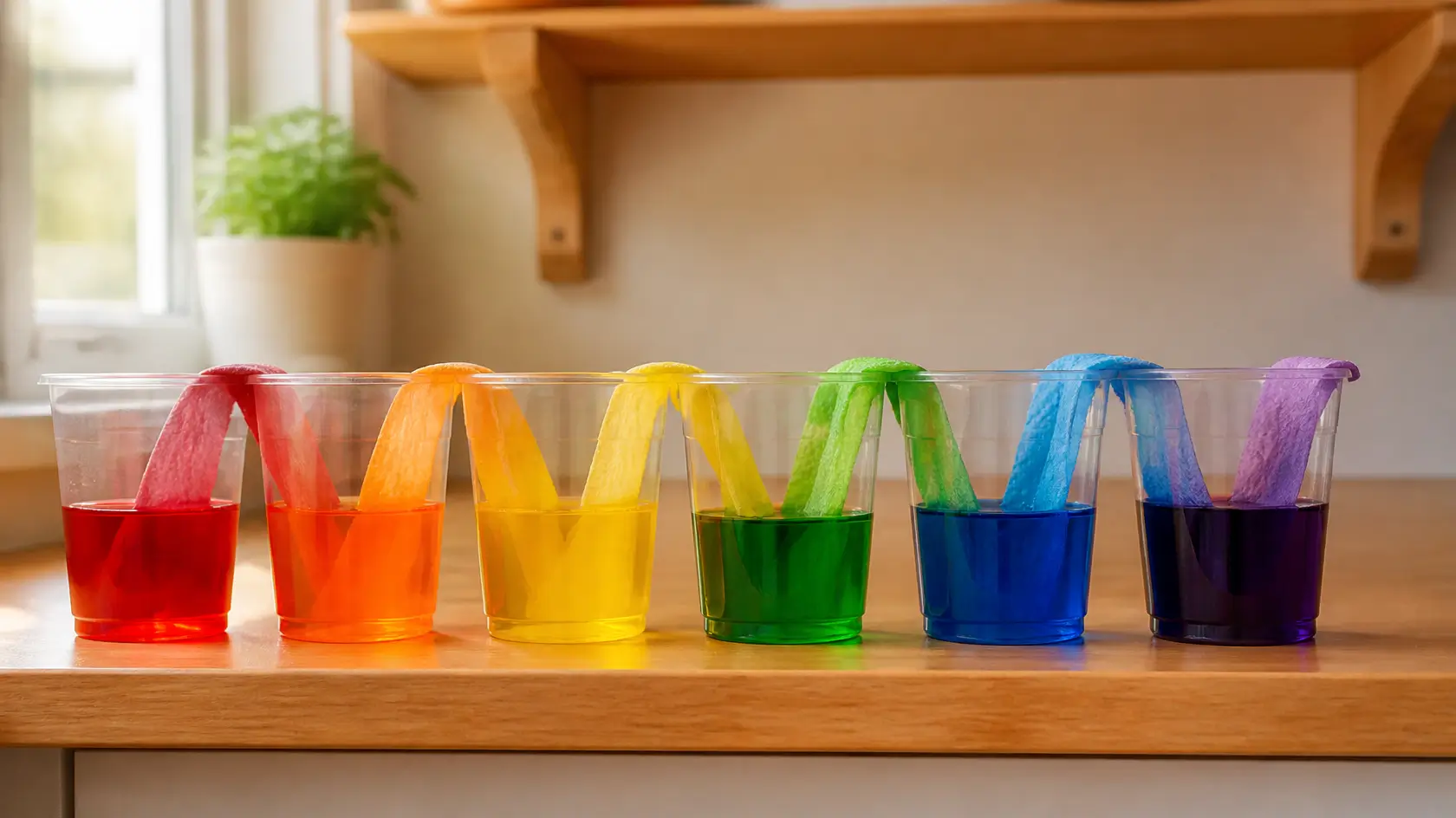
The walking water rainbow is a simple science experiment where coloured water climbs up folded paper towels and drips into empty cups, until the empty cups fill with new colours. It takes about 10 minutes to set up and about 2 hours to finish, and it works best for ages 3 to 5. You need 6 clear cups, water, red, yellow, and blue food colouring, and 5 paper towels — no measuring, no cooking, and nothing a preschooler cannot touch.
A child sets it up in the morning and checks it like a little scientist: after 30 minutes the towels are coloured, after 1 hour the empty cups have water in them, and after 2 hours there is a full rainbow in a row. The colours do the teaching. You only have to ask, “What do you see now?”
| Ages | 3 to 5 |
| Setup time | About 10 minutes |
| Waiting time | About 2 hours |
| Difficulty | Easy |
| Cups | 6 clear cups |
| Cost | Under $2 |
Safety first: food colouring stains hands, clothes, and tablecloths, so put an apron on the child and work on a tray. An adult should handle the food colouring bottles. The water is plain tap water and the paper towels are ordinary kitchen towels — nothing in this experiment is hot, sharp, or chemical.
What You Will Need
- 6 clear plastic cups, all the same size
- Tap water
- Red, yellow, and blue food colouring
- 5 paper towels, folded in half lengthways
- A tray with a rim, big enough for all 6 cups
- A dark green fabric cloth as your work surface, under the tray
- An apron or an old t-shirt for the child
Step 1: Gather Your Materials
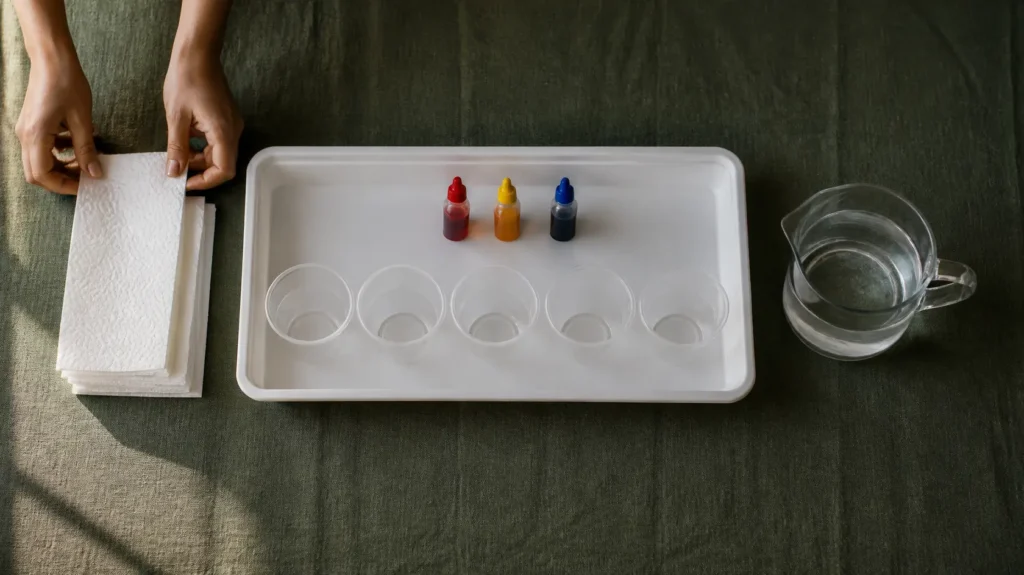
Lay everything out on the cloth before you start. Put the tray in the middle, the 6 empty cups in a row inside it, the 3 food colouring bottles behind them, and the 5 folded paper towels in a neat pile to one side. Fill a jug with tap water and put it beside the tray.
Do this first and the child never has to wait while you search for a cup. Waiting is when the paper towels get unfolded and refolded ten times.
Step 2: Line Up the Cups and Fill Three of Them
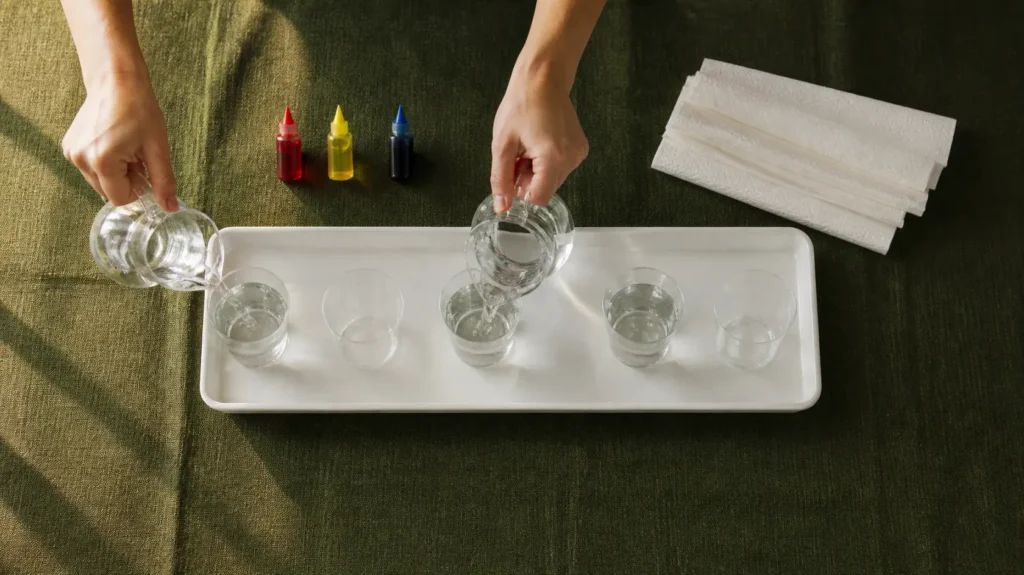
Put the 6 cups in a straight row inside the tray, touching each other. Fill the 1st, 3rd, and 5th cups about three-quarters full with water, and leave the 2nd, 4th, and 6th cups empty. The empty cups are the ones that will fill up by themselves — that is the whole point of the experiment, so do not fill them now, even if the child asks.
Count the cups out loud with the child: “One, two, three, four, five, six.” A preschooler who counts the cups understands the pattern before the colours even start.
Step 3: Add the Colours — Red, Yellow, Blue
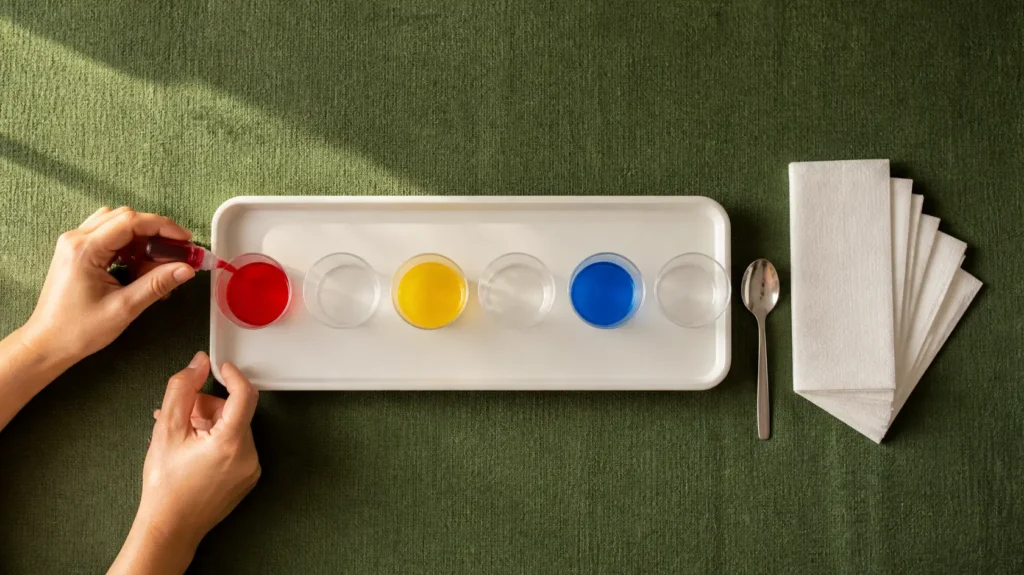
Add a few drops of red food colouring to the 1st cup, a few drops of yellow to the 3rd cup, and a few drops of blue to the 5th cup. Stir each one with a spoon until the water is one clear colour. The 2nd, 4th, and 6th cups stay empty and colourless.
Let the child choose which colour goes where, but keep the order red, yellow, blue. That order is what makes the rainbow — red and yellow make orange, yellow and blue make green, blue and red make purple.
Step 4: Put the Paper Towel Bridges In
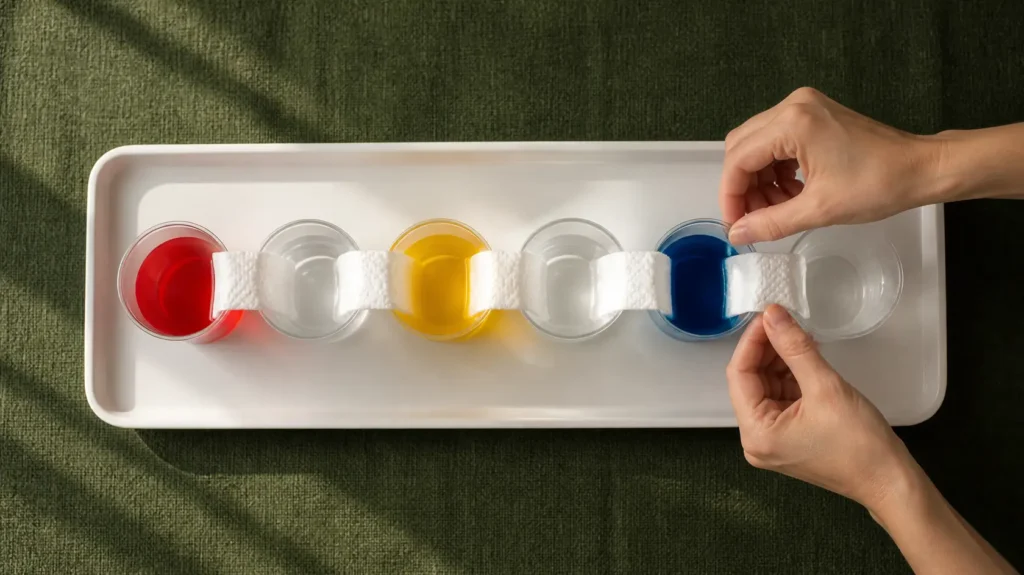
Take one folded paper towel and put one end in the red cup and the other end in the empty cup next to it. Do the same between every two cups, so there are 5 paper towel bridges in a row, each one dipping into two cups. Push the ends down until they touch the water in the full cups, and until they reach the bottom of the empty cups.
Work slowly here. If a towel bridge falls out, the water stops walking. Press each end down with a finger and check that it stays in the water before you move to the next one.
Step 5: Watch the Water Walk and Talk About It
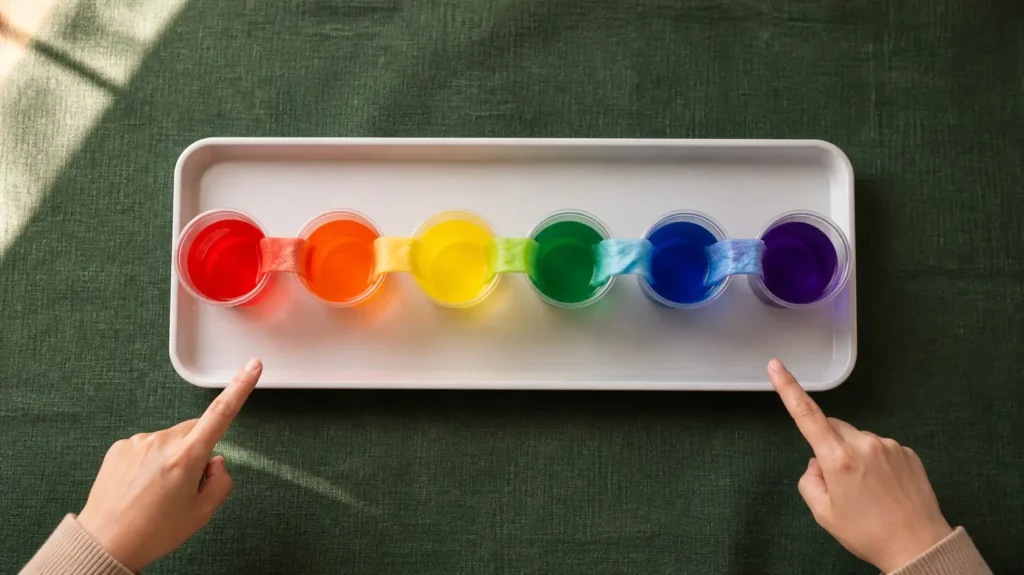
Leave the tray where the child can see it and do not touch it again. After about 30 minutes, the paper towels will be coloured all the way across. After about 1 hour, the empty cups will have water in them. After about 2 hours, the row will be a full rainbow: red, orange, yellow, green, blue, purple.
Check it together three times and ask the same question each time: “What do you see now?” The 2nd cup turns orange, the 4th cup turns green, and the 6th cup turns purple — and the child can tell you why, because they watched it happen.
Tips
- Use clear cups, not coloured ones. The child needs to see the water level rise in the empty cups.
- Fold the paper towels in half lengthways, not in quarters. A towel that is too thin dries out before the water reaches the next cup.
- Put the tray somewhere the child walks past — the kitchen table, not a high shelf. An experiment nobody checks is just wet paper.
- If one bridge dries out, push it back into the water and wait. The colours will start moving again in a few minutes.
- Take a photo at the start, after 1 hour, and at the end. The three photos side by side are the whole experiment, and they make a perfect Pinterest pin.
Variations
- Rainbow circle: put 7 cups in a circle instead of a row, with the same red, yellow, blue pattern, and watch the colours meet in the middle.
- Two colours only: use red and yellow only, with 4 cups, for a 3-year-old. The one new colour — orange — is easier to talk about than three.
- Night version: set it up before bedtime and check it first thing in the morning. The rainbow is finished overnight, and the child wakes up to a surprise.
Frequently Asked Questions
How long does the walking water experiment take?
About 2 hours from setup to a full rainbow. The paper towels colour in about 30 minutes, the empty cups start filling after about 1 hour, and the colours are at their brightest after 2 hours.
What age is the walking water experiment for?
Ages 3 to 5. A 3-year-old can watch and name the colours. A 5-year-old can set up the cups and predict which new colour each empty cup will turn.
Why is my water not walking?
The paper towel bridge is usually the problem. Check that both ends are pushed down into the water, and that the towel is folded in half, not in quarters. A thin towel dries out before the water reaches the next cup.
Can I use food colouring gel instead of liquid?
Liquid food colouring works best, because it mixes into the water straight away. Gel needs stirring and can leave dark spots at the bottom of the cup.
Is the walking water experiment safe for toddlers?
Yes, with an adult present. The water is plain tap water and the towels are ordinary kitchen towels. The only thing to watch is the food colouring, which stains — use an apron and work on a tray.